
 Login
Login
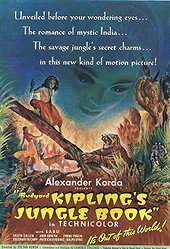
After blowing fellow child actor, Desmond Tester, out of the water with his naturalism in stark contrast to Tester’s stage-bound acting techniques, Sabu went on to star in his two best feature films. 1940’s remake of The Thief of Bagdad’s success can’t be solely credited to him, but since so much of the film is spent with him, a good chunk of its eternal optimism, mischievous spirit, and fun-loving vibe can be. And those same attributes here in 1942’s Jungle Book, once again returning to the world of Rudyard Kipling to tackle the author’s most-beloved character, Mowgli, the final film in the Korda-Sabu pairing.
This film holds a tremendous amount of nostalgia for me. As a child, I probably watched this version more often than the famous Disney film. Something about this version just stayed with me more.
Perhaps it was the brightly colored sets? One of the great things about cinema is its ability to create fantastical, imagined lands out of real places. This India has little standing in reality, but it is a creation of a child’s imagination. This opulent, magical jungle is the type that the mind conjures up while reading an adventure story. Shot by W. Howard Greene and Lee Games, Jungle Book is a technical marvel. Its combination of matte paintings, real sets, and Technicolor vibrancy add up to something whimsical and daring. It’s a richly realized world, one that is easy to get lost in.
Or perhaps it was Sabu? Looking back on it, he was probably one of my earliest cinematic crushes. His lean muscular body on proud display, and a handsome face with full lips and big, bright eyes probably caused some deep stirrings in my boyhood that I didn’t understand until later. His acting has also improved by this time, essaying the change from feral wild child to uneasily domesticated youth with ease and consummate skill. Sabu’s athleticism and charisma matured as he was, with this film being the perfect template for his particular brand of star persona.
Maybe it was all of the animals, both real and animatronic? Among the opulent sets are several engaging sequences in which trained animals are let loose. Granted, certain ones are entirely fake, both by design of the screenplay and by how dangerous the actual creatures were. Baloo the bear, Bagheera the panther, Raksha and Father Wolf, Shere Khan the tiger, and the various monkeys and deer are all live animals. They are anthropomorphized to a point, but nowhere near the way that they would become in Disney’s version. We’re told Mowgli can talk to the animals, and as the film progresses we begin to hear their voices. Mainly, two snake characters, the python Kaa and the old cobra Nag, are fakeries and heavy talkers.
For obvious reasons, these two characters are large rubber creatures. There’s something charming and quaint about these obviously artificial snakes. It adds to the mystique and fantasy of the film, in much the same way the dinosaurs do in King Kong. These are not real creatures, but imagined approximations of those creatures. While a dastardly effete villain in Disney’s version, Kaa is one of Mowgli’s trusted allies here. While Nag warns him of the dangers of the treasure he guards, giving Mowgli a talk about the destructive powers of man’s greed.
If Jungle Book has a flaw, it’s the third act which stretches on just a few minutes too long. I think shaving about ten minutes from this final section would have tightened up the pace. After ripping through at great speed and clarity through the various other adventures, our focus is pulled away from Mowgli for too long here, and we realize just how titanic Sabu was to making this entire enterprise work so smoothly.
Granted, the finale takes place in the beautifully wrought decaying ruins of a maharaja’s palace, so even if the pace is too slowly there’s still something beautiful to look at. Even better is the fiery scenes in which Mowgli eventually rejects “man’s world” and returns to the jungle. Mainly a grand spectacle, which is not a knock against the movie, Jungle Book is the kind of fine entertainment that rarely gets made anymore. I was only too happy to discover that the nostalgic glow this movie possessed in my memory was well-served. It is one that we should cherish.