
 Login
Login
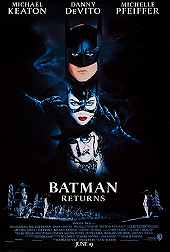
Paving the way for Christopher Nolan's fully-realised noir conceit of crime-riddled Gotham, Tim Burton's "Batman Returns" trounces every preceding version of the Caped Crusader's expansive sandbox. Gotham, as realised by Burton, is stylistically and visually reminiscent of German Expressionist cinema, albeit with flashes of kitsch and camp incorporated into the costumes and props, the sets swathed in snow, smog and shadows, all of which may seem incongruous, but once you are presented with it in action, it all coheres and works magnificently. With the arrival of his most well-drawn, complex adversaries, Penguin and Catwoman, the story takes place some time after the events of the first film with Batman assimilated into Gotham City as its resident masked vigilante.
Pursuing one such foe, Catwoman, sees Batman meet his match, and naturally, they develop a tenuous symbiosis in disguise and out. Catwoman, driven by a personal vendetta against ruthless businessman Max Shreck, slants Batman's moral compass, exposing his difficulty in separating an uncompromising obligation to Gotham and his underlying loneliness as Bruce Wayne. Crucial to this romantic dilemma is Catwoman's flirtatious sparring with Batman and her alter ego Selina Kyle's charged exchanges with Bruce Wayne. It is this sexual undertone and the over-arching theme of duality within the superhero mythos that elevates the film beyond mere comic book adaptation fare without substance. Anyone aware of the finer subtext of DC's greatest detective should recognise Batman as the dominant persona and Bruce Wayne the subterfuge - they are indivisible. This is a theory carried over to the rogues gallery's least represented villain, Penguin - abandoned at birth by his upper-class parents due to his physical deformity, a parallel of sorts that links him to all the first-born sons of Gotham, including Bruce Wayne. Tim Burton's affinity for misfits imbues his film with a discernible poignancy, thus elucidating and going some way to explain the motivations of Penguin, who is, despite his bizarre exterior and Machiavellian nature, a misunderstood victim of circumstance. On screen in the 1960s, the DC Rogues Gallery consisted of The Joker and then less formidable, easily overcome criminal outcasts he collaborated with written as two-dimensional opponents of Batman merely to fortify his strength and power as a morally upright hero. Penguin and Catwoman are as substantial and integral to the plot as Batman; these richly nuanced studies of the two expand and liberate the characters from their comic book trappings, peeling at the layers of their shattered psyches. It is simply a joy to behold Penguin and Catwoman as three-dimensional characters with hidden agendas marred by Batman's presence. Everything within that framework, the immensely evocative visuals, action-packed set pieces and astonishing performances, are of particular importance in establishing the filmmaker's strategy, which is primarily to satisfy the audience, but also provide comic book nerds with a low-key, understated Batman, far removed from any other in the lexicon in the sense that he is both wisecracking and stoic: an amalgam of the seriousness of the 1980s comics as well as the florid panache of the classic Adam West epitomisation. Batman's dependency on technology is more pronounced also, proving advantageous for his foil, who both form an uneasy alliance to destroy him by targeting these perceived strengths, only for Penguin's depraved nature to hilariously bring about its swift end. It is these additional strokes of genius with character development that allow the film to bypass all others in the canon. For example, this advance by Penguin also showcases Catwoman's newfound sexual magnetism in her slinky black suit, contrasting with her lack of success with men as Selina Kyle. It is extremely masterful screenwriting in motion, and it holds up remarkably well even after other writers have since caught onto the potential of fleshing out the back story of the more interesting villains the hero pursues.
"Batman Returns" was not as widely popular with audiences and critics as its predecessor owing to its strangeness, converging plotlines, stronger violence and sexual references. Suffused with humour in a black vein, the film's deeply rewarding screenplay courtesy of "Heathers" scribe Daniel Waters, is the vital component as well as its detriment; the reason it failed to connect with audiences on a universal scale is that such a packed narrative demands dissection as if it were a cult film - the attention to detail, in-jokes, and indelible lines recited. It is designed to be pored over as a standalone film or loose continuation of the 1989 origin story, not to be taken seriously as part of the wider mythology of Batman, it is so versatile in terms of tonality, it could fit into any category, even the Christmas movie. Demonstrating the tragicomic qualities of Bruce Wayne and his enemies more than any other incarnation, "Batman Returns" is an atmospheric microcosm of Burton's tortured Gothic sensibility and prevaling recondite zaniness that through commendable character work, indelible dialogue, astonishing set design, and a hauntingly romantic disposition rarely afforded to commercial cinema, is tempered and moulded into a great film loaded with much to explore if it elicits the same response in you as it does me.