

 Login
Login
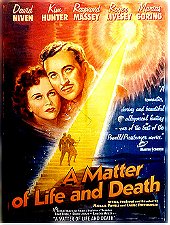
Much like James Stewart got a glimpse of the spiritual world in It’s a Wonderful Life and chose to remain in the corporeal, so too does David Niven’s RAF pilot opt to stay with the living. Of course, A Matter of Life and Death argues for the healing and redemptive power of love and mankind’s brotherhood, but there’s something trickier, even thornier, about how it goes about arguing these facts. While the dividing line between the afterlife and the living was easier to navigate in It’s a Wonderful Life, A Matter of Life and Death gives ample room for interpreting the afterlife as Niven’s imagination run wild.
After completely a successful air raid, Niven’s plane is struck, and his parachute is no good. He manages to contact American radio operator June (Kim Hunter), and spends what are clearly framed as his final moments speaking with her. His stiff upper lip in the face of demise pulls at your emotions, and June becomes our proxy for this. Except, Niven’s pilot manages to escape certain doom and washes ashore the next day with zero clue as to how he was spared.
Cut to heaven, a black and white bureaucratic netherworld of clean Art Deco design, where one of his compatriots argues that there’s been a mistaken and someone is missing. Heaven sends an emissary, Marius Goring essentially playing Maurice Chevalier, to investigate what exactly happened. Only Niven can see Goring and his ability to stop time/space around him, which lands Niven a series of tests for psychological issues or potential brain lesions.
Does this sound like abstract and high-concept stuff? Welcome to the cinematic world of the Archers, Michael Powell and Emeric Pressburger. Powell and Pressburger wrote, produced, and directed their films with an overpowering aestheticism that treated the cinema as a wonderland. They created a series of films that treated the cinema as an exercise in not just aesthetics, but esoteric moods and deep sensuality. Theirs was a cinema for people who wanted to overdose on the power of the movies.
This is all to say that they manage to make something so deeply strange and turn it into a deeply involving emotional journey. Niven’s trial, basically his ability to stay on earth or go back to heaven, is both an argument for the power of love and a cinematic extension of the special relationship between England and the United States in the immediate aftermath of WWII. Yes, this was intended as a morale booster for a country suffering from deep psychological scars in the aftermath of one of the bloodiest wars in history.
If the Archers wound up being enthusiastically optimistic, then who could blame them? England was still cleaning up the rubble of the blitz. They deserved a little poetry to help them heal, and A Matter of Life and Death is indeed cinematic poetry.
