

 Login
Login
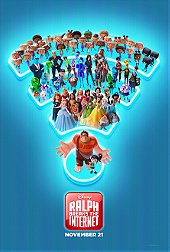
Let’s check in with Ralph and Vanellope after six years and see what’s new. Well, they’ve established a fun pattern of spending the day in their games, drinking root beers at Tapper’s, then talking the night away before repeating the cycle over again. But there’s a rippling in their friendship, a sense that one of them is perfectly content while the other yearns for a change, something larger.
Then, while the entirety of the arcade is hanging out in the power strip hub, something of a Grand Central Station for all the various game characters, something new is added – WiFi. Before you know it, something bad happens to Vanellope’s game, and she and Ralph embark on a journey to the internet to fix it. Kinda funny that Ralph both wrecks it then tries to fix it – isn’t some of that equation supposed to be Felix’s job?
Anyway, Ralph Breaks the Internet expands on its Toy Story-like conceit by introducing the wide world of the internet, online gaming, harsh comment sections, and embodiments of viral videos and online avatars. The story smartly integrates many of these elements and they feel like organic growths from the plot points, yet there’s also a weakness to overloading the narrative with so much. Ralph Breaks the Internet is best when it narrows its emotional scope and journey to evolving relationship between Ralph and Vanellope.
There’s plenty of humorous gags, like Twitter being a both of bluebirds in a tree chirping out literal dialog balloons, but the presence of so much vertical integration is a mixed bag. The presence of the Disney princesses, and their corporate-safe feminist redesign and jokes, is alternately incredibly humorous for its self-aware humor yet distracting for feeling yet another instance of Disney cannibalizing itself. Same goes for the cameos from Star Wars characters and Marvel properties, although a silent Stan Lee cameo is wonderfully melancholic.
Same goes for the presence of YouTubers either in quick cameos or minor supporting roles. I get that they’re aiming for a specific audience demographic, but the gag involving Miranda Sings is going to age like milk left on the counter in a few years. Ralph Breaks the Internet feels calculated and synergistic in these moments. A similar thing occurs when it pokes fun at viral videos and the concept of likes. It’s a bit of low hanging fruit to merely remake/remodel the videos with Ralph. All we’re missing is a bit of a “Vanellope bit my finger!” to complete the illusion.
Yet there’s the central heart of the film – the bond between Ralph and Vanellope – that keeps it charming and deeply touching throughout. It’s easy to read their relationship as longtime friends preparing to either go out in the workforce or off to college. Ralph’s perfectly content with the way things have developed and doesn’t see a need to change them. Vanellope wants something more, and even gets the requisite Disney princess “I wish/I want” song, one that gives a bit of Alan Menken’s classic bite from the Little Shop of Horrors days.
The strength and fluidity of this bond is pushed to the limits and everyone learns some life lessons along the way. It’s here that Ralph Breaks the Internet shines brightest and hits the hardest. Less so when Ralph, the Disney princesses, and Vanellope team up to take down the big bad, a phalanx of Ralph’s insecurities made corporeal. Ignore the shiny distractions and look at this film’s beating heart. It’s a vibrant and touching one.
