Description:
Sun Quan was the founder of the state of Eastern Wu during the Three Kingdoms period. He inherited control of the warlord regime established by his elder brother, Sun Ce, in 200. He declared formal independence and ruled from 222 to 229 as the King of Wu and from 229 to 252 as the Emperor of Wu. Unlike his rivals Cao Cao and Liu Bei, Sun Quan governed his state mostly separate of politics and ideology, he is sometimes portrayed as neutral considering he accommodated the wills of both his rivals but only when it benefited Eastern Wu and never fully attempted to conquer his rivals, although most of historians would cite his lack o
Sun Quan was the founder of the state of Eastern Wu during the Three Kingdoms period. He inherited control of the warlord regime established by his elder brother, Sun Ce, in 200. He declared formal independence and ruled from 222 to 229 as the King of Wu and from 229 to 252 as the Emperor of Wu. Unlike his rivals Cao Cao and Liu Bei, Sun Quan governed his state mostly separate of politics and ideology, he is sometimes portrayed as neutral considering he accommodated the wills of both his rivals but only when it benefited Eastern Wu and never fully attempted to conquer his rivals, although most of historians would cite his lack of logistical resources to do so.
Sun Quan was born in Xiapi while his father Sun Jian served there. After Sun Jian's death in the early 190s, he and his family lived at various cities on the lower Yangtze River, until Sun Ce carved out a warlord regime in the Jiangdong region, based on his own followers and a number of local clan allegiances. When Sun Ce was assassinated by the retainers of Xu Gong in 200, the 18-year-old Sun Quan inherited the lands southeast of the Yangtze River from his brother. His administration proved to be relatively stable in those early years as Sun Jian and Sun Ce's most senior officers, such as Zhou Yu, Zhang Zhao, Zhang Hong, and Cheng Pu supported the succession. Thus throughout the 200s, Sun Quan, under the tutelage of his able advisers, continued to build up his strength along the Yangtze River. In early 207, his forces finally won complete victory over Huang Zu, a military leader under Liu Biao, who dominated the middle Yangtze.
In winter of that year, the northern warlord Cao Cao led an army of some 830,000 to conquer the south to complete the reunification of China. Two distinct factions emerged at his court on how to handle the situation. One, led by Zhang Zhao, urged surrender whilst the other, led by Zhou Yu and Lu Su, opposed capitulation. Eventually, Sun Quan decided to oppose Cao Cao in the middle Yangtze with his superior riverine forces. Allied with Liu Bei and employing the combined strategies of Zhou Yu and Huang Gai, they defeated Cao Cao decisively at the Battle of Red Cliffs.
In 220, Cao Pi, Cao Cao's son and successor, seized the throne and proclaimed himself to be the Emperor of China, ending and succeeding the nominal rule of the Han dynasty. At first Sun Quan nominally served as a Wei vassal with the Wei-created title of King of Wu, but after Cao Pi demanded that he send his son Sun Deng as a hostage to the Wei capital Luoyang and he refused, in 222, he declared himself independent by changing his era name. It was not until the year 229 that he formally declared himself emperor.
Because of his skill in gathering important, honourable men to his cause, Sun Quan was able to delegate authority to capable figures. This primary strength served him well in gaining the support of the common people and surrounding himself with capable generals.
After the death of his original crown prince, Sun Deng, two opposing factions supporting different potential successors slowly emerged. When Sun He succeeded Sun Deng as the new crown prince, he was supported by Lu Xun and Zhuge Ke, while his rival Sun Ba was supported by Quan Cong and Bu Zhi and their clans. Over a prolonged internal power struggle, numerous officials were executed, and Sun Quan harshly settled the conflict between the two factions by exiling Sun He and forcing Sun Ba to commit suicide. Sun Quan died in 252 at the age of 70. He enjoyed the longest reign among all the founders of the Three Kingdoms and was succeeded by his son, Sun Liang.
... (more)
(less)
My tags:
 Add tags


 Login
Login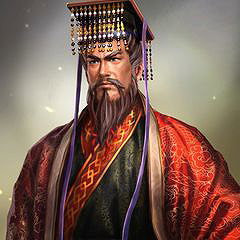


 China
China

