Description:
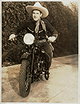
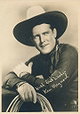
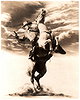
Image is everything in Hollywood. Few stars were ever as disliked within the business but held in such high regard by fans as Ken Maynard. To never have met Maynard was reportedly a blessing. And despite his innumerable personality shortcomings, no other western star of the period had so many opportunities thrown his way. Maynard's press releases would have you believe he was a circus performer, WWI vet, championship rodeo rider and native Texan. In truth, he was definitely none of these things; he was born into a large Indiana family (three sisters and his genuinely affable younger brother Kermit Maynard who followed him, far l
Image is everything in Hollywood. Few stars were ever as disliked within the business but held in such high regard by fans as Ken Maynard. To never have met Maynard was reportedly a blessing. And despite his innumerable personality shortcomings, no other western star of the period had so many opportunities thrown his way. Maynard's press releases would have you believe he was a circus performer, WWI vet, championship rodeo rider and native Texan. In truth, he was definitely none of these things; he was born into a large Indiana family (three sisters and his genuinely affable younger brother Kermit Maynard who followed him, far less successfully, to Hollywood). Ken spent his boyhood around Columbus, Indiana and eventually attended, but not graduated from, Indiana University. Exactly how he became an expert horseman is not really known, but he managed to become quite accomplished in the saddle. His earliest appearance on film was in a non-western with William Fox's studio and scored good notices with a secondary role in Janice Meredith (1924) as Paul Revere. Figuring it was better to be a big fish in a small pond, Ken signed with independent low budget producer, J. Charles Davis and became a star in its low budget releases, $50,000 Reward (1924) and The Grey Vulture (1926). From there he signed with Fox's First National Pictures and remained with it after it was sold off to Warner Brothers, starring in some twenty silent westerns. Ken, at this point was in his prime and at the top of his game with audiences. With his palomino Tarzan, he was world famous. Unfortunately, he also had an enormous ego with a temper to match, and he had an unfailing habit of alienating almost everyone he worked with. Unlike his brother Kermit, Maynard was widely considered to be an arrogant jackass - he drank heavily and spent his large salary like a drunken sailor. He lavished a fortune on women, fancy cars and even had his own airplane. In 1929, he accepted a lucrative offer from Carl Laemmle to jump to Universal. Uncle Carl offered Ken his own company and creative control, which put him into the ranks of Hoot Gibson (then ranking as Universal's premier western star), the aging Tom Mix and his predecessor, the great William S. Hart. He joined Universal during the sound transition period and made eight respectable pictures there. For the 1931-32 production season, the studio, riding high with its homegrown monster craze, opted to ditch westerns altogether and Ken, who Laemmle had quickly grown to dislike, found himself on the wrong side of the studio's gates (Gibson too found himself unemployed and his career would wane considerably). With his name still an asset, Ken returned to Poverty Row, working out of Tiffany for producers William Saal and Phil Goldstone. Despite the considerable loss of production values, the eleven films he ground out there were popular Saturday matinée entries that satisfied the hundreds of independent theaters that then-existed across the U.S. and Canada. Unfortunately for Ken, he hitched his future to a falling star: Tiffany was floundering and sank under the weight of its sub-par non-western product and went under in 1932. Its former boss, Samuel Bischoff joined forces with Saal and producer Burt Kelly to form K.B.S. Film Co. (with distribution by World Wide Productions) with the express purpose of producing Ken Maynard westerns. These entries were slightly better budgeted than those at Tiffany but still hampered by a notable lack of production values. This company was short-lived, biting the dust within a year. Universal, which abruptly returned to westerns in 1933, decided to give Ken another shot. Between 1933 and 1934, Ken starred in eight generously budgeted oaters and, more importantly, gave him financial control over his unit. This arrangement became a flash point with Laemmle, since Ken routinely exceeded the $100,000 or so allotted for each film (roughly ten times what his Tiffany and K.B.S. releases had cost). Cost overruns resulted in angry, profanity-laden meetings with Universal's front office personnel. Laemmle's deep dislike for Ken hit the breaking point and he was shown the door a second time, replaced by Buck Jones as the studio's reigning sagebrush star. He was likely oblivious to the fact that his career had peaked since he quickly signed with Nat Levine's flinty Mascot Pictures, where he made the feature In Old Santa Fe (1934) and a serial, Mystery Mountain (1934). As Mascot's biggest star, he began to stick his nose in areas that were unappreciated by Levine. His star cussed out casts and crews alike; his ego was out of control and he was loathed by everyone. A director reportedly showed Levine outtakes from one of his profanity-laden outbursts and Maynard was fired. Once again, fate sided with Maynard as this event coincided with Tim McCoy's departure from Columbia Pictures. The studio had only recently broken out of the ranks of Poverty Row status and boss Harry Cohn wanted to remain a player in the lucrative western genre. Working with veteran producer Larry Darmour, Ken starred in eight Columbia oaters, beginning with Western Frontier (1935) directed by Al Herman and the rest by Spencer Gordon Bennet. From there he signed with Monogram, only recently reformed after its boss' brief interlude as part of Republic (see Trem Carr). Working at low-budgeted Monogram displeased Ken tremendously and he made everyone aware of its many real and perceived shortcomings. By 1938 his weight ballooned and his popularity nosedived and his future film work was limited. With so many bridges figuratively burned during his career, his acting career came to an end by the mid-40s. With nowhere else to go, Ken turned to the big top, working for the Cole Brothers-Clyde Beatty Circus, playing off his former film glory. Having blown through a fortune, old age and alcohol did not treat him kindly. Married multiple times, Ken's last wife, Bertha died in 1968 and he found himself living largely off meager Social Security checks. His final years were tainted by his association with a girlfriend who encouraged him to sell phony memorabilia. He lived in a cheap trailer park, drank heavily and suffered from ill health. Ken died largely forgotten and in poverty at the Woodland Hills Motion Picture Home on March 30, 1973.
... (more)
(less)
My tags:
 Add tags


 Login
Login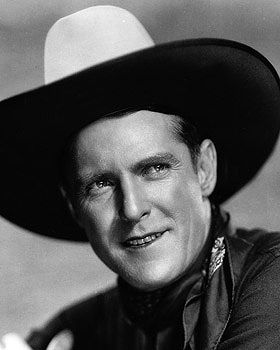


 United States
 1 comment