Description:
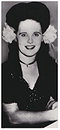
The Black Dahlia" was a nickname given to Elizabeth Short, an American woman who was the victim of a gruesome and much-publicized murder. Short acquired the moniker posthumously by newspapers in the habit of nicknaming crimes they found particularly colorful. Short was found mutilated, her body sliced in half at the waist, on January 15, 1947, in Leimert Park, Los Angeles, California. Short's unsolved murder has been the source of widespread speculation, leading to many suspects, along with several books and film adaptations of the story. Short's murder is one of the oldest unsolved murder cases in Los Angeles history.
The Black Dahlia" was a nickname given to Elizabeth Short, an American woman who was the victim of a gruesome and much-publicized murder. Short acquired the moniker posthumously by newspapers in the habit of nicknaming crimes they found particularly colorful. Short was found mutilated, her body sliced in half at the waist, on January 15, 1947, in Leimert Park, Los Angeles, California. Short's unsolved murder has been the source of widespread speculation, leading to many suspects, along with several books and film adaptations of the story. Short's murder is one of the oldest unsolved murder cases in Los Angeles history.
Elizabeth Short was born in Boston, Massachusetts; she grew up and lived in Medford. She was the third of five daughters of Cleo Short and Phoebe Mae Sawyer. Her father built miniature golf courses until the 1929 stock market crash, in which he lost much of the family's assets. In 1930, he parked his car on a bridge and vanished,[5] leading some to believe he had committed suicide. Short's mother moved the family to a small apartment in Medford and found work as a bookkeeper. It was not until later that Short would discover her father was alive and living in California.
Arrest photo from 1943 for underage drinking
Troubled by asthma and bronchitis, Short was sent to live for the winter in Miami, Florida, at the age of 16. She spent the next three years living there during the cold months and in Medford the remainder of the year. At age 19, Short travelled to Vallejo, California, to live with her father, who was working nearby at Mare Island Naval Shipyard on San Francisco Bay. The two moved to Los Angeles in early 1943, but an altercation resulted in her leaving there and finding work in the post exchange at Camp Cooke (now Vandenberg Air Force Base), near Lompoc, California. Short next moved to Santa Barbara, where she was arrested on September 23, 1943, for underage drinking. Following her arrest, she was sent back to Medford by the juvenile authorities in Santa Barbara. Short then returned to Florida to live, with occasional visits back to Massachusetts.
In Florida, Short met Major Matthew Michael Gordon Jr., a decorated United States Army Air Forces officer who was assigned to the 2nd Air Commando Group and in training for deployment to China Burma India Theater of Operations. Short told friends that Gordon wrote her a letter from India proposing marriage while he was recovering from injuries sustained from an airplane crash. She accepted his proposal, but Gordon died in a second airplane crash on August 10, 1945, before he could return to the United States. She later exaggerated this story, saying that they were married and had a child who died. Although Gordon's friends in the air commandos confirmed that Gordon and Short were engaged, his family denied any connection after Short's murder.
Elizabeth Short returned to Los Angeles in July 1946 to visit Army Air Corps Lieutenant Joseph Gordon Fickling, an old boyfriend she had met in Florida during the war. At the time Short returned to Los Angeles, Fickling was stationed at NARB, Long Beach. For the six months prior to her death, Short remained in southern California, mainly in the Los Angeles area.
The body of Elizabeth Short was found in the Leimert Park district of Los Angeles on January 15, 1947. Her remains had been left on a vacant lot on the west side of South Norton Avenue midway between Coliseum Street and West 39th Street (at 34.0164°N 118.333°W). The body was discovered by local resident Betty Bersinger, who was walking with her three-year-old daughter around 10 a.m.; Bersinger initially mistook the body for a discarded store mannequin. Upon realizing it was a corpse, Bersinger rushed to a nearby house where she phoned the police.
Short's severely mutilated body was severed at the waist and completely drained of blood. Her face had been slashed from the corners of her mouth toward her ears, creating an effect called the Glasgow smile. Short also had multiple cuts on her thigh and breasts, where entire portions of flesh had been removed. The body had been washed and cleaned and had been "posed" with her hands over her head, her elbows bent at right angles, and her legs spread.[1][5] Near the body detectives found a cement sack which contained droplets of watery blood, as well as a heel print on the ground amidst tire tracks.
The autopsy stated that Short was 5 feet 5 inches (1.65 m) tall, weighed 115 pounds (52 kg), and had light blue eyes, brown hair, and badly decayed teeth. There were ligature marks on her ankles, wrists, and neck. Although the skull was not fractured, Short had bruising on the front and right side of her scalp with a small amount of bleeding in the subarachnoid space on the right side, consistent with blows to the head. The cause of death was hemorrhage from the lacerations to the face and shock due to blows on the head and face.
William Randolph Hearst's papers, the Los Angeles Herald-Express and the Los Angeles Examiner, sensationalized the case: The black tailored suit Short was last seen wearing became "a tight skirt and a sheer blouse" and Elizabeth Short became the "Black Dahlia," an "adventuress" who "prowled Hollywood Boulevard." As time passed, the media coverage became more outrageous, with claims that her lifestyle had "made her victim material."
On January 23, 1947, someone claiming to be the killer called the editor of the Los Angeles Examiner, expressing concern that news of the murder was tailing off in the newspapers and offering to mail items belonging to Short to the editor. The following day, a packet arrived at the Los Angeles newspaper containing Short's birth certificate, business cards, photographs, names written on pieces of paper, and an address book with the name Mark Hansen embossed on the cover. Hansen, an acquaintance at whose home she had stayed with friends, became a suspect. One or more persons would later write more letters to the newspaper, calling himself "the Black Dahlia Avenger," after the name given to Short by the newspapers. On January 25, Short's handbag and one shoe were reported seen on top of a garbage can in an alley a short distance from Norton Avenue, and then finally located at the dump.
The grave of Elizabeth Short
Due to the notoriety of the case, more than 50 men and women have confessed to the murder, and police are swamped with tips every time a newspaper mentions the case or a book or movie about it is released. Sergeant John P. St. John, a detective who worked the case until his retirement, stated, "It is amazing how many people offer up a relative as the killer."
Gerry Ramlow, a Los Angeles Daily News reporter, later stated, "If the murder was never solved it was because of the reporters... They were all over, trampling evidence, withholding information."[citation needed] It took several days for the police to take full control of the investigation, during which time reporters roamed freely throughout the department's offices, sat at officers' desks, and answered their phones. Many tips from the public were not passed on to police, as the reporters who received them rushed out to get "scoops."
Short was buried at the Mountain View Cemetery in Oakland, California. After Short's sisters had grown up and married, Short's mother moved to Oakland to be near her daughter's grave. Phoebe Short finally returned to the east coast in the 1970s and lived into her nineties.
-Source Wikipedia
... (more)
(less)
Tags: Murdered (2), Died 1947 (2), Born 1924 (2), Born In MA (1), California (1), Gruesome Death (1), The Black Dahlia (1), Born July 29 (1), Died Aged 22 (1), Died Young (1), Elegant (1), Died (1), Lovely (1), Gone Too Soon (1), Mysterious Death (1), Deceased (1), Beautiful (1), Los Angeles (1)
My tags:
 Add tags


 Login
Login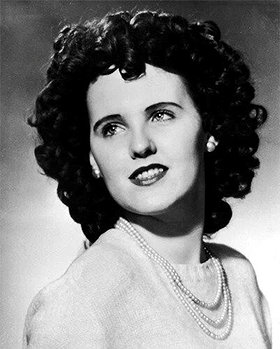


 United States





 Famous Murders/Assassinations (10 person items)