

 Login
LoginKidoky
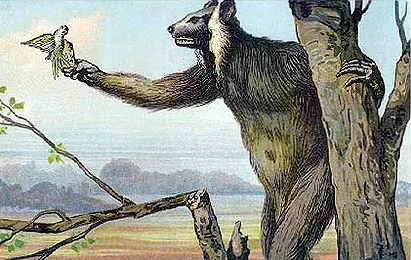


The Kidoky is a little-known cryptid reportedly inhabiting the dry forests and shrublands of Madagascar’s Menabe region. Its existence was documented through interviews with local residents conducted by Dr. David A. Burney and Ramilisonina in the mid-to-late 1990s, with their findings later referenced in American Anthropologist.
Described as a large, lemur-like primate, the kidoky resembles a sifaka but is said to be distinctly different. Witnesses describe it as far larger—about the size of an eight-year-old child (roughly 55 pounds)—with a dark coat, white facial markings, and a round, human-like face. Unlike arboreal sifakas, the kidoky is reportedly entirely ground-dwelling, fleeing on foot rather than climbing trees, and emits a loud, whooping call similar to that of an indri.
Because of its size and vocalizations, Burney and Ramilisonina speculated that the kidoky might represent an unknown or relict population of indri, though its ground-based behavior and heavier build set it apart. Other researchers, including cryptozoologist George Eberhart, have proposed that it could be a surviving population of an extinct lemur, such as archaeolemur or megaladapis. However, these theories are complicated by anatomical differences, as archaeolemurs were quadrupedal, while the Kidoky is said to move upright in a hopping manner similar to modern sifakas and indris.
Overall, the Kidoky remains an unresolved mystery, possibly rooted in lingering populations of extinct lemurs or misidentified known species, preserved through local oral tradition.
Described as a large, lemur-like primate, the kidoky resembles a sifaka but is said to be distinctly different. Witnesses describe it as far larger—about the size of an eight-year-old child (roughly 55 pounds)—with a dark coat, white facial markings, and a round, human-like face. Unlike arboreal sifakas, the kidoky is reportedly entirely ground-dwelling, fleeing on foot rather than climbing trees, and emits a loud, whooping call similar to that of an indri.
Because of its size and vocalizations, Burney and Ramilisonina speculated that the kidoky might represent an unknown or relict population of indri, though its ground-based behavior and heavier build set it apart. Other researchers, including cryptozoologist George Eberhart, have proposed that it could be a surviving population of an extinct lemur, such as archaeolemur or megaladapis. However, these theories are complicated by anatomical differences, as archaeolemurs were quadrupedal, while the Kidoky is said to move upright in a hopping manner similar to modern sifakas and indris.
Overall, the Kidoky remains an unresolved mystery, possibly rooted in lingering populations of extinct lemurs or misidentified known species, preserved through local oral tradition.


Your Rating:
Tags:
My tags:
 Add tags


